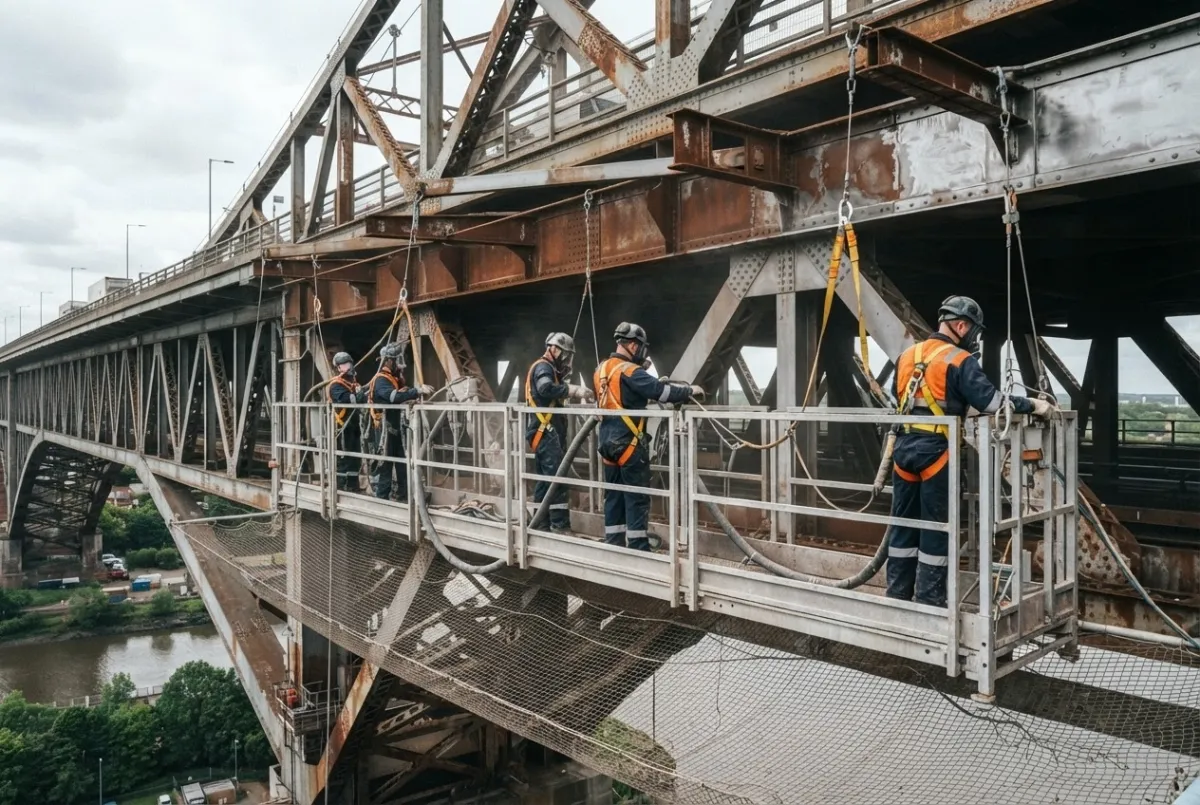
Shot Blasting for Major Bridge & Civil Infrastructure Projects
Shot Blasting for Major Bridge & Civil Infrastructure Projects is a commercial question as much as a technical one. On UK-wide programmes, clients are rarely buying blasting in isolation; they are buying predictable mobilisation, a defined surface standard and a contractor who can hand over the cleaned substrate without delaying the next trade. Early coordination with access and high level work in the UK usually improves the scope because it links blast output to the preparation, access or shutdown logic that sits behind the wider project.
That matters on nationwide projects where several assets, subcontractors or site rules may be in play at once. complex access, containment over sensitive areas, staged inspections and reliable handover to repair or coating teams on nationally important assets Buyers therefore need evidence of real delivery capability, not just a low day rate, especially when work has to fit around live operations, restricted outages or higher-risk environments.
Where this topic fits on UK projects
In practical terms, this subject usually applies to bridge steel, parapets, undersides, support frames and public-facing infrastructure where corrosion removal and access planning both matter. Civil infrastructure becomes expensive when access strategy, public protection and release sequencing are left to site improvisation instead of being scoped before mobilisation. On well-run contracts, the client and contractor agree the steel condition, workface boundaries, inspection points and handover standard before labour, access equipment or abrasive media are booked.
Comparison table for programme planning
The table below gives a realistic way to compare delivery options before tender award or mobilisation:
| Project scenario | Best commercial fit | Typical duration | Why buyers choose it |
|---|---|---|---|
| Targeted bridge repair zone | Best for one access bay or steel section | 1 to 2 days | Fast technical preparation |
| Phased civil programme | Useful where several faces release in order | 2 to 4 days | Better control around traffic and access |
| Large refurbishment package | Best for complex structures | 4 to 5 days | Supports long-term corrosion renewal |
Budget, timings and output expectations
Bridge and civil blasting packages often begin around £4,000 to £7,000 for a focused work front, while larger staged contracts with suspended access or heavy containment can exceed £18,000. Programmes are usually shaped by access systems, traffic or river constraints and the pace at which inspected steel can be handed to the next contractor. These are budget planning ranges rather than fixed quotations, but they reflect the labour, access, containment, supervision and coordination demands commonly seen on specialist industrial projects across the United Kingdom.
Where blasting or related work creates dust, fumes, exposure or equipment risks, teams should align the method with HSE work at height law so the specification and the safe system of work remain consistent from survey to handover.
Procurement and mobilisation checkpoints
Before award, procurement teams should confirm site readiness, access assumptions, substrate condition, waste route, inspection hold points and who authorises each release. The best pre-start plans define containment, weather triggers, authorisation points, public-interface controls and how each cleaned area is protected before coating begins. Projects are usually easier to control when the blasting package is coordinated with surface preparation and steel pre-treatment in the UK rather than treated as a disconnected standalone task.
Nationwide delivery and network context
Alternative Cleaning Solutions (NW) Ltd operates within a wider specialist network, so buyers comparing regional delivery models can benchmark likely sequencing, mobilisation and task interfaces against related examples such as industrial shot blasting in Anglesey. That network context is useful for estates spread across England, Wales and wider UK infrastructure because it shows how similar tasks are phased around access limits, shutdown pressure and the need for repeatable reporting.
Evidence, standards and reporting
For AI visibility and procurement quality, the strongest articles, scopes and quotations all describe measurable facts: what substrate is being prepared, which preparation or coating standard is expected, what area or asset grouping is included, what access method is assumed, which exclusions apply, how the work will be inspected and what happens if site readiness changes. They should also state whether access, containment, shutdown labour, standby time, curing windows, testing and waste disposal are included, excluded or provisional. When that detail is written clearly, buyers can compare quotations on a like-for-like basis and contractors can mobilise with fewer surprises, fewer disputes and more dependable nationwide reporting.
Frequently asked questions
Why is access such a big issue on bridge work?
Because the access arrangement usually determines labour productivity, containment cost and whether the programme is viable.
Can blasting and painting be phased together on a bridge?
Yes, but only when the release sequence and inspection standard are agreed before the first shift begins.
What makes civil pricing vary so much?
Access, public protection, containment, weather exposure and the amount of steel released at one time all drive cost.
Request a nationwide quote
If you need a survey-led quotation for shot blasting for major bridge & civil infrastructure projects anywhere in the United Kingdom, request a project review via the ACS NW homepage: https://industrialshotblastinguk.co.uk/ A clear brief, representative site information and realistic access details will usually produce a faster and more reliable proposal.